Rising
Flood Risks
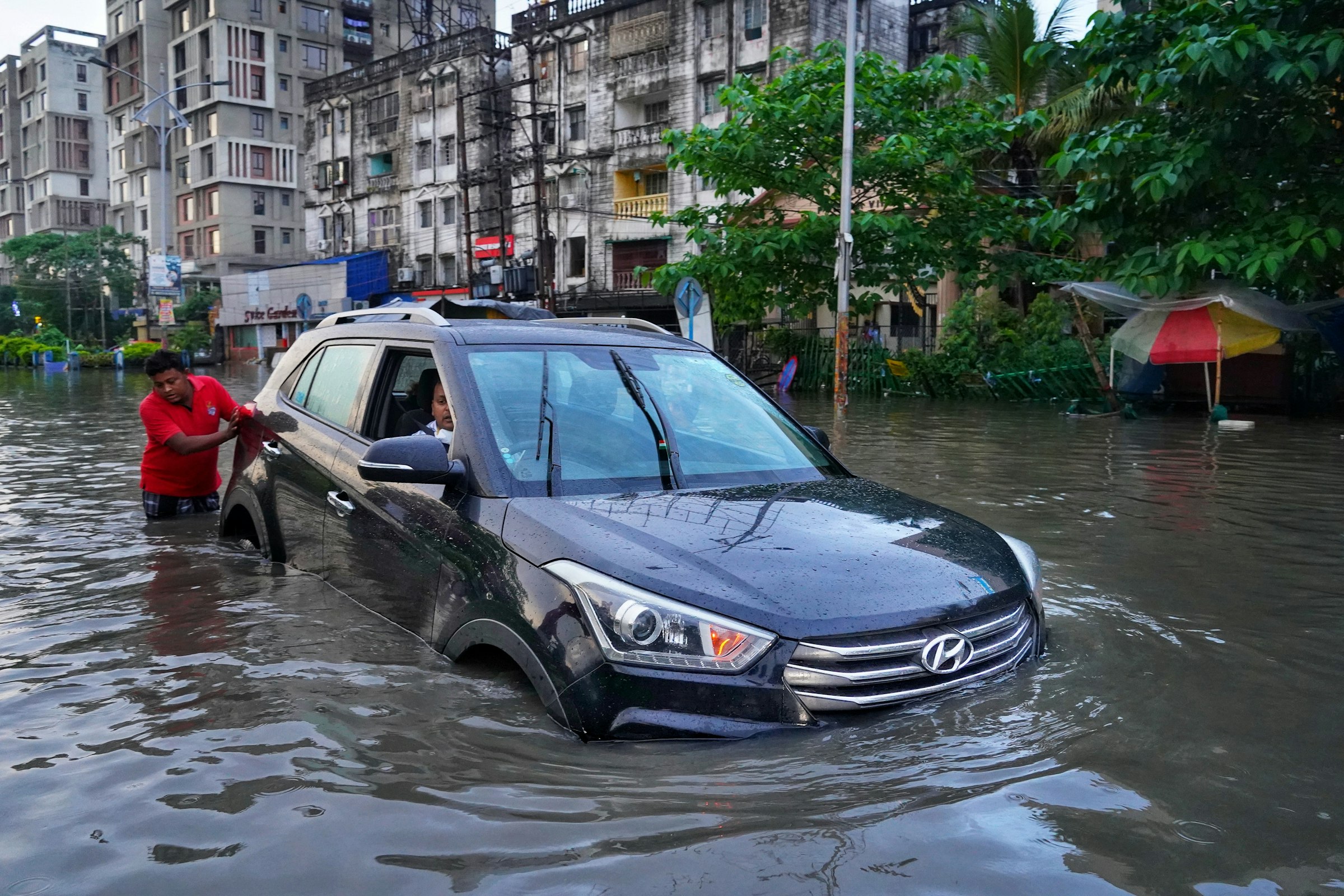
Flooding remains one of the most destructive natural perils in India and the Global South. Urban pluvial losses have doubled to $4 billion annually — and without intervention, could reach $30 billion by 2070.
$4B
Annual Urban Flood Losses
India (2024 est.)
$30B
Projected Losses by 2070
(High Scenario)
102%
Growth in Built-up Areas
in Flood-prone Zones (1985–2015)
1.0%
India Non-Life Penetration
(% of GDP, FY 2024-25)
Introduction
Flooding is the world's most frequently occurring and one of the most economically damaging natural perils globally. In India and across the Global South, its impact is compounding — driven by rapid and often unplanned urbanization, the encroachment of built-up areas onto floodplains and wetlands, and the intensifying effects of climate change on monsoon patterns, sea-level rise, and extreme precipitation events. Unlike many natural hazards, flood risk does not respect boundaries: it affects agriculture, infrastructure, residential property, commerce, and industry simultaneously, cascading across economic sectors and supply chains.
India's exposure is particularly acute. With over 40 million hectares classified as flood-prone — roughly 12% of the country's total land area — and some of the world's most densely populated river deltas and coastal cities sitting directly in the path of recurrent flood events, the country faces an escalating risk profile that its insurance sector has yet to adequately price or absorb. Annual average urban pluvial flood losses to the Indian economy have historically in the past decade averaged USD 3–4 billion, but recent projections suggest this figure is rising steeply as urban exposure intensifies.
Despite the scale of exposure, India's non-life insurance penetration remains stubbornly low at 1.0% of GDP for FY 2024-25, according to India's insurance regulator. Flood-specific insurance products are nascent, largely confined to commercial lines and government-backed crop schemes, leaving the vast majority of households, small businesses, and infrastructure assets wholly unprotected. The result is a chronic and widening protection gap — one that forces governments, communities, and individuals to bear losses that capital markets could, with the right product design, absorb far more efficiently.
Catalyst Insight
Even a modest improvement in non-life penetration — from 1.0% toward 2% — combined with flood-specific products and parametric triggers, could significantly reduce India's post-disaster fiscal burden and accelerate recovery across the most vulnerable communities.
Flood Exposure & Urban Vulnerability
Between 1985 and 2015, built-up areas in India's high flood-risk zones expanded by over 102%, according to the World Bank's “Towards Resilient and Prosperous Cities in India” (2025). Nationally, the population exposed to 1-in-100-year floods has grown from 8.6 million in 2000 to 11.1 million in 2023, and could reach 25–46 million by 2070 depending on climate trajectory — concentrated in India's largest coastal and riverine cities, including Mumbai, Kolkata, Surat, Delhi, and Chennai.
Population Exposed to 1-in-100-Year Floods: India National Total (2000–2070)
Source: World Bank, “Towards Resilient and Prosperous Cities in India” (2025), Table 2.1 — national aggregate; EarthRe analysis. No city-level population breakdown is published in the source.
Insurance Coverage & Protection Gaps
Catalyst Insight
India's flood protection gap is not simply a market failure — it is a structural underinvestment in risk transfer that leaves governments as the insurer of last resort for hundreds of millions of people. Closing even a fraction of this gap through targeted flood products represents one of the most impactful opportunities in the Global South reinsurance market today.
Economic & Sectoral Impact
The economic consequences of flooding extend far beyond the immediate physical destruction of property and infrastructure. Supply chain disruptions, agricultural output losses, displacement of labour, and long-term degradation of urban productive capacity compound the direct damage. For India, where agriculture still accounts for a substantial share of rural livelihoods and where urban economic density is rising rapidly, the multiplier effects of flood losses are particularly severe — and increasingly difficult to absorb without structured risk transfer.
Projected Annual Pluvial Flood Losses in India — Historical to 2070 (USD Billion)
Source: World Bank, “Towards Resilient and Prosperous Cities in India” (2025); New Indian Express (2025); EarthRe analysis. 2070 estimate: the source's narrative text cites $14–30B, while its own Table 2.1 gives a $4.3–29.9B range for the same year — both are reported as-is, not reconciled.
Strategies & Forward Outlook
Parametric & Index-Based Products
Parametric flood covers — tied to objective triggers such as rainfall depth, river gauge levels, or satellite-derived inundation maps — deliver accelerated payouts without the delays and disputes of traditional loss adjustment. For India's most flood-exposed populations, parametric structures offer the speed of recovery that indemnity products cannot match.
Bundled Microfinance & Insurance
Bundling affordable flood cover with microfinance products, housing loans, and agricultural credit allows insurers to reach low-income urban and rural segments at scale. Embedding coverage within existing financial products reduces distribution costs and increases uptake among populations that would never seek out standalone insurance products.
Collaborative Regional Risk Pooling
Transboundary flood risks — shared across river basins spanning India, Bangladesh, Nepal, and Bhutan — are too large for any single national market to absorb alone. Regional risk pools, modelled on the Caribbean Catastrophe Risk Insurance Facility or the African Risk Capacity, provide a mechanism for spreading correlated losses across a broader capital base while reducing per-country premium burdens.
Strategic Outlook
The convergence of rising urban flood exposure, improving remote sensing and hydrological data, and growing regulatory appetite for inclusive insurance creates a unique window for insurers and reinsurers to build durable flood books in India. Those who invest now in product design, risk modelling, and distribution partnerships will be positioned to lead the market as the demand curve steepens over the next decade.
Conclusion: Proactive Insurance for a Flood-Prone Future
India's flood risk trajectory is unambiguous: rising exposure, urbanizing floodplains, intensifying monsoon variability, and a chronic underinvestment in risk transfer create a compounding vulnerability that no amount of post-disaster relief can sustainably address. The gap between the economic losses that floods inflict and the insurance recoveries that follow is not just a market statistic — it is a measure of unmet need, of households that rebuild slowly, of businesses that do not reopen, and of governments that must repeatedly divert development budgets toward disaster recovery.
Closing this gap requires a genuine product innovation effort: flood-specific covers that are affordable, fast-paying, and accessible to the full spectrum of Indian society, from smallholder farmers in Bihar to commercial property owners in Mumbai. It requires reinsurers willing to provide the long-term capacity that primary insurers need to write flood risk with confidence, and data infrastructure capable of supporting credible pricing at the local level. EarthRe is building precisely this capability — combining geospatial flood modelling, parametric product structuring, and reinsurance capital deployment to support cedants across India's most exposed geographies.
The window to act is open. Urban expansion into flood-prone areas continues at pace; climate projections grow more sobering with each successive IPCC assessment; and the regulatory environment in India — with The regulator's progressive stance on product innovation and distribution — has never been more conducive to launching the next generation of flood insurance solutions. The choice facing the market is not whether flood risk will grow, but whether the insurance sector will grow with it.
Catalyst Series Conclusion
In markets where flood exposure is doubling every generation, every basis point of insurance penetration represents millions of lives and assets brought under the protection of capital. The time to act is before the next monsoon — not after.
Data References
- 1.World Bank (2025) — Towards Resilient and Prosperous Cities in India — urban flood exposure, built-up area growth, and city-level projections.
- 2.World Bank Press Release, July 22, 2025 — India has a critical opportunity to drive resilient urban development.
- 3.The Economic Times, December 31, 2025 — Life insurance penetration remained unchanged in 2025 at about half of global average.
- 4.Handbook on Indian Insurance Statistics 2024-25 — non-life penetration, density, and segment data.
- 5.The New Indian Express, July 25, 2025 — urban flooding loss to touch $5 billion by 2030 in Indian cities.
About the Author

Mr. Malay Kumar Poddar
CEO & Executive Director · EarthRe
Malay Poddar is a veteran crop-insurance and rural risk leader with decades of experience across India's premier public insurers. He began his career at GIC, building deep expertise in agricultural underwriting and program execution across multiple states.
He joined the Agriculture Insurance Company of India at its inception and played a key role in shaping and operationalizing India's flagship crop-insurance schemes. After a senior leadership stint at National Insurance Company, he returned to AIC as Chairman-cum-Managing Director, guiding the organization's rapid expansion and modernization.
More from Catalyst
Related Articles

IFSC in GIFT City: Emerging as a Ship Leasing Hub and Its Potential to Become a Centre for Marine Insurance Pools
 Siddesh Ramasubramanian
Renewable Energy Insurance Growth in India: Market Insights and Projections for 2025-2026
 Mr. Shivakhumar R.S.